| Agnus Dei |
brass band without percussion (July 11, 2008);
a short (about one minute, 40 seconds) calm, meditative composition, scored
simply - essentially a seven-part arrangement reflecting the brass
septet; brass band version is in the key of B-flat; see the description
of the vocal version (above) for more information. |
| Bur Oak Suite |
brass band; Roots (January 15, 2007),
Trunk (January 15, 2007), Canopy (November 24, 2006; later
renamed Acorn and made the first movement); premiere performance
of the brass band version by the Sheldon Theatre
Brass Band April 28, 2007, with Glen Newton playing E-flat
tenor horn; premiere performance of the new fourth movement, Treetop,
by the Sheldon Theatre Brass Band June 27, 2008, with Glen Newton playing
B-flat baritone horn; see the description of the trombone
choir version (below) for more information. Glen supplied these program notes: |
| |
|
The
Bur Oak (botanical name Quercus macrocarpus) is native to the Eastern
half of North America. This very large shade tree was honoured in 2001 by
being selected ‘Urban Tree of the Year’ by the Society of Municipal
Arborists. ‘Bur Oak Suite’ is a Four Movement Suite in tribute
to this majestic tree. Each movement suggests a part of the tree.
The first movement, Acorn,
is inspired by the Bur Oak’s large shaggy acorn, which is a compact
precursor to the entire tree.
The second movement, Roots,
is sombre and solid, as are the roots of the tree; it includes further
development of one of the themes introduced in Acorn.
The third movement, Trunk,
is characterised by upward movement, suggestive of the nutrients that
flow from the roots of the treetop.
The final
movement, Treetop, is a lively representation of the activity
in the upper branches of the Bur Oak - the sunlight, leaves blowing in
the wind, squirrels jumping about, birds singing and even a woodpecker.
Its own soaring theme is complemented by quotes from the themes of the
earlier movements.
|
|
| Christmas is Just 'Round the Corner |
vocal solo with brass band (October 23, 2012; first performed as part of the Sheldon Theatre Brass Band holiday concerts November 23 and 24, 2012, with vocalist Debbie O'Keefe) and vocal solo with big band (November 4, 2012; first performed by the Roseville Big Band at Augustant Chapel View Residence November 27, 2012, with vocalist Karen Dunn) |
| John Henry, Brass-Driving Man |
brass band (March 19, 2007; based on the trombone choir arrangement "John Henry's Hammer", but with a revised introduction, various lines updated, and using the additional tonal resources of the brass band; three percussion parts: drum set, mallet percussion, and tympani; first performed by the Sheldon Theatre Brass Band July 11, 2007, in a park in Red Wing, Minnesota, with Glen Newton playing principal trombone); Click here to hear a sampler (987KB MP3) of the brass band version of John Henry. Recorded by the Sheldon Theatre Brass Band and simply called "John Henry" on their CD "Black, White, and Blue with a Swing Chaser" (2009), which is available from CDbaby.com. Revised August 26, 2012, to add another trombone and turn it into a feature for three or four trombones. Click here to see the four-trombone version in a YouTube video.Glen supplied these program notes:
|
|
In the classic American folk song, John Henry, is a steel-drivin’ man. But in this updated arrangement, John Henry is a brass-drivin’ man. As the song begins, we hear John Henry’s father (played by the 1st Trombone) give his advice to the youth, who is about to join the brass band that his forebears have played in for more than a century. Then the grandfather (played by the Bass Trombone) gives his own advice. Next we hear from the ambitious John Henry himself (played by the 2nd Trombone), who is full of youthful swagger and eager to prove himself worthy of the family’s brass traditions.
And what a time he has of it! The swinging feeling of the fixed-tempo section tells us that John Henry thoroughly enjoys brass banding and the Trombone section unisons and harmonized passages demonstrate that he fits right in. Yet there is a cloud on the horizon; the centre section of the arrangement is introspective, as John Henry thinks about his mother and sister (played by the Solo Bb and Soprano Cornets), who chose to play Flute and beg John Henry to quit the brass band and play chamber music with them.
But there is a happy ending! After a short family conference, the women in his life agree with John Henry that brass banding is really a form of chamber music - for a big chamber - so they take up brass instruments and join the band, as the arrangement moves to a new, higher key for its joyous conclusion. |
|
| Marble |
brass band (September 10, 2006; revised July
7, 2008); originally for horn sextet; premiere of the brass band version by the Lake Wobegon Brass Band of Anoka, Minnesota, October 5, 2012, at First Presbyterian church in St. Paul; also performed by LWBB October 7, 2012, at Anoka High School; see the
description of the trombone choir version (below)
for more information. |
| Sorta Samba |
brass band (September 3, 2012); originally for trombone choir; this version eliminates the repeat in the interlude and replaces the improvised solos with band passages and short notated solos; percussion parts are for drum set (same as in the Big Band version) and xylophone. |
| The Express |
brass band (February 2010, arranged by Robert Collinson; not yet published); performed by the Sheldon Theatre Brass Band July 4, 2010, in the Red Wing, Minnesota, band shell, and at Bridge Square in Northfield, August 6, 2010, as part of the Vintage Brass festival, and on August 7, 2010, in the Sheldon Theatre in Red Wing; originally for concert band; also performed by several British brass bands who bought the music from Broadnib Music; described below. |
A Brief Fantasy on
'Sheep May Safely Graze' |
two trombone choir versions: four
parts (TTTB) and two four-part choirs (each TTTB); originally written for
tuba/euphonium quartet;
rescored for 2 clarinets, horn, and bassoon; also scored for large saxophone
ensemble: up to 2 sopranos, 4 altos, 2 tenors, 2 baritones, and bass sax
(August 30, 1980; performed by the House Brand Woodwind
Ensemble at Sperry-Univac Shepard Road facilities April
21, 1981; performed in the early 1980's by the Minneapolis Trombone
Choir; performed by the Minneapolis Trombone Choir and Student Trombone
Choir, February 27, 2000; saxophone version performed by a saxophone septet,
the Glen Newton Saxophone Ensemble,
as the postlude for the July 16, 1989, Sunday morning worship service of
St. Anthony Park United Methodist Church). Click
here to hear a recording (633KB MP3) of the February 27, 2000 performance. |
| Brown Wore Black |
six parts (A/T, T, T, T/B, T/B, B) plus rhythm
section; (January 16, 2003; premiered by the Minneapolis Trombone Choir,
February 23, 2003, at Judson Memorial Baptist Church, Minneapolis, Minnesota).
Dedicated to the volunteers of CTV15 public access television. Also performed
April 17, 2003, by the University of Wisconsin—Eau Claire trombone
choir, under the direction of Rodney B. Hudson. Although they were guests
on the Minneapolis Trombone Choir concert, they didn't play on this selection
on that program. Also arranged for Big Band. |
| Bur Oak Suite |
Roots, Trunk, and Canopy;
six parts (A/T,T,T,T/B,T/B,B; February 3, 2000; premiered by the Minneapolis
Trombone Choir, February 27, 2000, at Judson Memorial Baptist Church, Minneapolis,
Minnesota; also performed by the University of Minnesota Trombone Choir,
April 24, 2002, Nick Castonguay, conductor). Click the title of the movement
to hear the April 24, 2002, performance of Roots
(2.5MB MP3) and Trunk
(964K MP3) and the February 27, 2000, performance of Canopy
(1.3MB MP3). Also arranged for brass band. |
| Chain Mail |
three parts (T,T,T/B; November 26, 2014; later revised for 8-part trombone choir and renamed Waterfalls) |
| Cinema Roll |
eight parts with optional tuba (T, T, T, T, T/B, T/B, B, B/Tuba); January 28, 2017; premiered by the Minneapolis Trombone Choir, March 26, 2017, at Judson Memorial Baptist Church, Minneapolis, Minnesota. Glen wrote this description for the program: |
| |
Cinema Roll is music you might hear as the credits roll at the end of a movie. Aha! There's your name as the script writer! What does the music suggest about your movie? Is it a buddy movie about two trombonists on a road trip? As you listen, use your imagination to fill in the plot. Then celebrate your movie premiere and today's premiere performance of Cinema Roll with a cinnamon roll. |
|
| Fanfare and Meditation |
eight parts in two choirs (choir A (T,T,T/B,T/B) and choir B (T,T, T/B,B)); January 26, 2013; premiered by the Minneapolis Trombone Choir, March 17, 2013, at Judson Memorial Baptist Church, Minneapolis, Minnesota. Also performed by the MTC March 23, 2014. Glen wrote this description for the program: |
| |
Fanfare and Meditation presents two contrasting themes in surround sound. After the opening antiphonal fanfare, the two trombone choirs, one on each side of the audience, take turns imitating each other in the meditation. If you listen carefully, you might hear the fanfare try to intrude on the meditation, only to fade away as the meditation continues. Then see if you can hear a game of one-upmanship, as each statement and echo begins with a little bit longer lead-in than the one before. And what’s this? The meditation theme seems to have picked up some of the martial character of the fanfare, increasing until the entire trombone choir repeats the fanfare motif, each of the eight trombone parts chasing after the one next to it! The result is a complete triumph of the fanfare … or is it? Glen composed this piece for the Minneapolis Trombone Choir, which is giving the premiere performance this afternoon. |
|
| Marble |
six parts (A/T,T,T,T,T/B,B) plus two offstage
solo trombones; also arranged for brass band;
originally for horn sextet (trombone choir version
1997, performed by the Minneapolis Trombone Choir, February 23, 1997,
and again February 27, 2005; part 6 updated for the 2005 performance to
add a contrabass trombone, sometimes doubling in unison, other times doubling
at the octave or resting.) Glen wrote this description for the program
of the trombone choir's 2005 concert: |
| |
Marble
– by Glen Newton. You are standing in a huge marble hall
when a four-note motif bursts forth, followed by an echo. You turn, trying
to find the source of the sounds, as the motif expands into a 32-bar theme
that appears in several guises as the notes cascade around the hall. Low
trombones introduce a waltz that fills the hall until the dramatic return
of the first theme in surround sound. Marble was Glen Newton’s 1979
entry in the International Horn Society Composition Contest. The Minneapolis
Trombone Choir premiered this trombone choir version in 1997. |
|
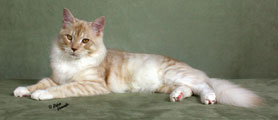
| The Maine Coon Cat Waltz |
six parts (T,T,T,T/B,T/B,T/B) plus rhythm section: piano/guitar, bass, drums; February 8, 2014; premiered by the Minneapolis Trombone Choir, March 23, 2014, at Judson Memorial Church. Also arranged for Big Band. Glen wrote this description for the program:
|
| |
The Maine Coon Cat Waltz by Glen Newton (b. 1947) is a lighthearted jazz waltz for six-part trombone choir that features a call-and-response arrangement and improvisation by two of the Minneapolis Trombone Choir’s fine soloists. The title honors SoftNotes Red Cloud of Gator Maine, a Maine Coon Cat who is light on his feet. |
 |
|
| Road Trip |
eight parts (T,T, T, T, T, T/B, B, B); January 22, 2011; premiered by the Minneapolis Trombone Choir, March 20, 2011, at Judson Memorial Church. Also performed by the Totino-Grace High School trombone choir on their May18, 2013, pops concert, whose theme was "road trip", and by the University of Wisconsin - River Falls Trombone Choir on their Mpve,ber 12, 2013, concert. Glen wrote this whimsical description for the MTC program: |
| |
Road Trip by Glen Edward Newton (b. 1947) depicts a typical drive to a cat show – something Glen and his wife, Jo, have done many times. As the trip begins, you can imagine the early morning sun breaking through the fog. When the car reaches the interstate, the tempo picks up and we’re on the way! As the day progresses, the cats in their carriers meow their greetings and sing four-part harmony with their humans. Calm sections of the piece depict rest stops providing a respite from the pulsing 6/8 rhythm of the open road. Finally, the familiar logo of the show motel comes into view, and humans and felines check in and rest up for the weekend’s competition. |
|
| Slide on a Stick: A Day at the Fair |
eight parts (T,T,T,T,T,T/B,B,B); January 22, 2012; premiered by the Minneapolis Trombone Choir, March 18, 2012, at Judson Memorial Church. Glen supplied this description for the program: |
| |
Slide on a Stick: A Day at the Fair depicts a day at the Minnesota State Fair, where just about every food imaginable - and even some beverages - is offered "on a stick". Our musical journey follows a little girl, thrilled with the sights, sounds and tastes of the fair as she walks around with her parents. After a while, she takes a nap in her stroller and dreams of flying. When she wakes up, they're in the International Bazaar, where a mariachi band is playing! Finally, her dream comes true as the family takes the sky ride and flies over the hectic activity below. |
|
| Because the version of this composition performed by the MTC moves through the keys of Bb, D, Gb, A, and back to Bb and includes relatively difficult bass trombone parts, Glen created an alternate version, suitable for a high school trombone choir (T,T,T,T,T,T,T,T/B) that sticks to more familiar keys (Bb, C, F, Ab, Bb), limits the 8th part range to Bb below the staff, and avoids a low B, thus making it playable on a single-rotor instrument. |
| Sorta Samba |
five parts (T,T,T/B,T/B, B) plus rhythm section:
piano; guitar and bass; or any combination of these with drums; (January
24, 2002; premiered by the Minneapolis Trombone Choir, February 24, 2002).
The melody and chords are the same as the vocal quartet and Big Band instrumental,
It's Too Late (for Us to Start Again) and the brass band version. |
| Trombone Graffiti |
five parts (T,T,T,T/B,B; January 26, 1999; premiered
by the Minneapolis Trombone Choir, March 7, 1999, at Judson Memorial Church;
also performed by a Hopkins High School trombone quintet Friday, June 4,
1999, at the Hopkins High School Theater) |
| Two by Four |
two four-part choirs (choir A: T,T,T,T/B; choir B: T,T,T,B) with rhythm section and optional tuba; February 24, 2016; to be premiered by the Minneajpolis Trombone Choir, March 20, 2016, at Judson Memorial Church. Glen supplied this description for the program: |
| |
Two By Four takes its name from the two four-part trombone choirs that play it, assisted by a tuba and rhythm section. The first theme, a jazzy, carefree tune, provides the basis for improvised solos by members of the Minneapolis Trombone Choir. It gives way to a dignified second theme performed without the aid of the rhythm section. As that theme develops, little snippets of jazz from the first theme intrude, first by a few instruments, then by more and more, until the dignity is thrown aside and overwhelmed by the carefree first theme. Listen for one last fleeting attempt of the dignity theme to assert itself during the final chorus. |
|
| Waterfalls |
two four-part choirs (choir A: T,T,T,T/B; choir B: T,T,T,B, with optional tuba part on portions of the choir B4 part; January 31, 2015; premiered
by the Minneapolis Trombone Choir, March 22, 2015, at Judson Memorial Church).
Also played by the UWRF Trombone Choir at the St. Paul Cathedral, April 10, 2016. Glen supplied this description for the program: |
| |
|
Waterfalls presents a landscape in stereo. Imagine a waterfall that splashes on rocks before flowing downstream. Then imagine another, then another, as the two four-part trombone choirs take turns depicting the natural beauty of waterfalls. The scene opens on an overcast day, but soon a ray of light breaks through, first on one side, then the other, and the sun shines briefly before the clouds reappear and rain complements the sight and sound of the surrounding waterfalls. At last the clouds part and both choirs join to proclaim the majesty of the sunlit waterfalls. |
|
| Agnus Dei |
Brass septet version for E-flat cornet, two B-flat cornets,
E-flat tenor horn, B-flat baritone horn, euphonium, and tuba (June 9, 2007);
also two variations of the ten-piece brass ensemble (November 28, 2008):
the brass band ten-piece ensemble - three B-flat cornets, E-flat horn, two
treble clef trombones, treble clef euphonium, E-flat bass in treble clef,
and one percussionist, or the orchestral ten-piece ensemble - three B-flat
trumpets, French horn in F, two trombones in bass clef, euphonium in bass
clef, tuba in bass clef, and one percussionist; all in the key of B-flat;
see the description of the vocal version (above) for more
information. |
| Barely Bossa Nova |
concert band; later rescored for orchestra; still
later rescored for big band (band 1977; premiere performance by the Roseville
Comunity Band in Roseville's Central Park, July 1977; orchestra version
1978 performed by the St. Anthony Civic Orchestra
7/16/78 at Columbia Heights Amphitheater, 7/28/78 at Apache Plaza in St.
Anthony, 8/3/78 at Pioneer Park in Stillwater, 7/7/81 at Coon Rapids Dam,
7/16/81 at Pioneer Park in Stillwater, 7/23/81 at Apache Plaza in St. Anthony, and 8/6/81 at Lake Harriet
Band Shell in Minneapolis, as well as concerts in May and September 7, 1996, and three
summer concerts in 2007: Chandler Place Ice Cream Social June 21, Salo Park
June 28, and Como Park Lakeside Pavilion July 1; big band version performed
by the Roseville Big Band at the Central Park band shell August
6, 1991, with Glen Newton playing the piccolo solo, and July 4, 1994,
with Kris Rusterholz playing the piccolo
solo; trombone choir version 1/24/2004 for two choirs, each TTTB, plus maracas,
claves, and vibra-slap, first performed by the Minneapolis Trombone Choir
February 29, 2004.) |
| Cat
Show Calypso |
steel drums, xylophone, marimba, hand claps/hi-hat
cymbal, shakuhachi, vocal "doos", and string bass (2000; based
on the second part of Trombone Graffiti; used in the sound
track of the video "Etoile du Nord Cat Show, February, 2000";
also played at the August 2000 ACFA International Awards Banquet in Sioux
Falls, South Dakota). Click
here for a 20KB MIDI file; its balance, timbres, and overall sound will
depend on the MIDI implementation on your system. Click
here to play a 1.5MB MP3 recording created on Glen's MIDI hardware. |
Chanson sans
Raison d'Etre |
piano solo (November 1967) |
| Chaser |
originally for flugelhorn, euphonium, and tuba;
later rescored for other trios: three French horns, three saxophones (alto,
tenor, and baritone), and trumpet, horn and euphonium (or treble clef baritone)
(1979; performed on the St. Anthony Civic Orchestra Brass Quintet concert
at the Minneapolis Institute of Arts, August 26, 1979, by Wally Warhol,
flugelhorn, Carol Jensen, euphonium, and Glen Newton, tuba) |
| The Elements |
Water, Air, Earth, and Fire;
composed for the 1983 West Bank School of Music
composers' workshop; Water was written for trumpet, three tenor
saxes, piano, and percussion; Air was written for synthesizer, two
flutes, bassoon, piano, and mark tree; Earth was originally for tuba,
euphonium , bassoon, clarinet, piano, and field drum, later rescored for
saxophone ensemble (SAA(A)T(A)BBass) and also for double brass quintet (3
trumpets, flugelhorn, 2 French horns, 2 trombones, and 2 tubas); Fire
was written for alto shawm/rackett/bassoon, E-flat trumpet/piccolo
trumpet/soprano trombone/alto horn, bass
clarinet, synthesizer, piano, and percussion (original 1983, premiered at
Macalester College May 22, 1983, and performed again at the Walker Art Center
May 29, 1983; Earth scored for brass dectet October 3, 1987; Earth
scored for saxophone ensemble and performed by the Glen Newton Saxophone
Ensemble, June 16, 1989, during the offertory at St. Anthony Park United
Methodist Church.); the chorale tune of Earth formed the basis for movement
one (Roots) of Bur Oak Suite for trombone
choir |
The Express
(originally called Glory Forever) |
concert band (started in 1958, finished February 1, 1977);
performed by the Roseville Community Band May, 1977, at Alexander Ramsey
High School (which is now Roseville Area High School), and both July 4,
1994 (with Glen as the guest conductor), and July 29, 1986, at the Roseville Central Park band shell; performed
by the Pullman, Washington, Community Band in 1977; performed in 1979 by
the Grand Rapids, Michigan, Shrine "Million Dollar" Band; performed
by the Bloomington
Medalist Band under the direction of Earl Benson, May 4, 1980, in the
Landmark Center in St. Paul, on a concert sponsored by the Minnesota Composers
Forum, and rebroadcast on Minnesota Public Radio on July 4, 1981; the Medalist band also performed it again on July 18, 2010; performed
by the Champlin Park High School Symphonic Band under the direction of Steven
G. Lyons March 22, 2009, at the Benson Great Hall on the campus of Bethel
University, Arden Hills, Minnesota, as part of a joint concert with St.
Cloud State Wind Ensemble and Mankato West High School Concert Band; also
performed by the 451st Army Band); performed by the Shoreview Northern Lights Variety Band, with Glen as guest conductor, at a Como Park Pavilion concert June 4, 2010, and on their portion of the band festival on July 18, 2010, with Glen as guest conductor; performed by the University of Wisconsin River Falls Symphonic Band on a middle school outreach program December 6, 2013, and on their March, 2014, tour, that included
Baldwin-Woodville HS and Whitehall HS, both in Wisconsin, a large high school in Des Plaines, Illinois, and a senior care facility in Des Plaines.
Also rescored for large saxophone ensemble: E-flat sopranino, C soprano, 5 B-flat sopranos, 6 altos, C melody, 4 tenors, 2 baritones, bass, and drums -- with a number of these parts being optional. |
| Hippo-Go-Lucky |
bass clarinet quartet or French horn quartet (May
29, 1982); this tune later formed the the basis for the theme of movement
three (Canopy) of Bur Oak Suite for
trombone choir. |
| Lament for Maxie |
tuba-euphonium duet (September, 1981) |
| Little Cathy |
Big Band (1966, based on the 1965 vocal version,
but never performed; score only; see the list
of high school compositions for the details) |
| Marble |
French horn sextet (1979); horn sextet version 1979, recorded
by Carol Jensen (1), Tom Samsel (2),
Chuck Powell (3), Steve Ecklund (4), Alisa Nelson (5), and Alice Thompson-Williams
(6) on October 6, 1979, in the St. Anthony Civic Orchestra rehearsal room
and submitted to the 1979 International Horn Society Composition Contest;
the results were reported in The Horn Call, April 1980: Marble was one of
17 works submitted for multiple horns but did not win the prize, which went
to Horn Players' Retreat and Pumping Song by David Stanhope). Also
arranged for brass band; see the description of
the trombone choir version (above) for more information.
|
| March Monday |
violin solo with piano, although I only wrote out
the violin part (and played the piano part from memory when I accompanied);
dedication: "for Steffie" (March 28, 1983) |
Minnesota -
State of the Art |
originally written for piccolo, three clarinets,
bass clarinet, French horn, and guitar; later rescored for large saxophone
ensemble: S(S)AA(AA)TTB(B)(Bass); incorporates motifs from the Blue Danube
Waltz, St. Paul Waltz, and Minnesota Rouser (composed November 1981 using
the pseudonym Mannheim Lars "Manny" Others, and performed by the
House Brand Woodwind Ensemble at Sperry-Univac Roseville plant 11/25/81
and in the Sperry-Univac Shepard Road plant cafeteria 12/14/81; sax ensemble
adaptation 1983, performed at St. Anthony Park United Methodist Church by
the Glen Newton Saxophone Ensemble.) |
| Minnesotaise |
jazz waltz for flute and rhythm section (December
23, 1981) |
| Passacaglia |
symphony orchestra (November, 1977; premiered by
the St. Anthony Civic Orchestra March 4, 1979, at St. Anthony High School
and performed by them August 24, 1991, at Uskela Church in Salo, Finland,
as part of their 1991 tour; also performed on the St. Anthony Civic Orchestra's
"Home Grown Music" concert Sunday, November 22, 1998, at the St.
Anthony Community Center) |
| Roses |
piano solo (1981) |
| Sandy on Sunday |
piano solo (March, 1983) |
| Sandy's Shuffle |
trumpet, trumpet/trombone, and rhythm section (December
3, 1968) |
| Series 600 Cassette
Training Video Sound Track |
organ, guitar, bass guitar, drum set, tuba, euphonium,
trombone, bass trombone, trumpet, horn, vibraphone, and miscellaneous hand
percussion; sound track for a Sperry-Univac training film (May 27, 1979;
recorded by Glen Newton, who also did the voiceovers for the film; used
as part of standard training program 1979-1982) |
| Sonatina |
woodwind quintet: flute, oboe, clarinet, horn,
and bassoon (August 26, 1978; performed by a woodwind quintet from the St.
Paul Civic Orchestra at the St. Paul Civic Orchestra New year's Eve Ball
12/31/81; also played at workshops sponsored by the New Friends of Chamber
Music in the Twin Cities, Minnesota) |
| Suite in C Minor |
brass sextet: 2 trumpets, horn, trombone, euphonium,
tuba; also transcribed for piano and organ duo (original August 29, 1962;
played by a brass sextet from Northwestern College at Landmark Center, St.
Paul, on a Minnesota Composer's Forum concert November 14, 1978, with Lynn
Erickson on trumpet, Doug Reader on trombone, and others; piano/organ duo
created August 30, 1963, and performed by Glen Newton (piano) and Dorothy
Newton (organ) at the United Church of Big Rapids, September 17, 1967.) |
| Theme/Song |
original instrumentation was clarinet, oboe/English
horn, French horn, cello, and vibes; composed for a West Bank School of
Music composers' workshop; later rescored for a combination of woodwind
octet (2 oboes, 2 clarinets, 2 horns, and 2 bassoons) and brass ensemble
(piccolo trumpet, 2 B-flat trumpets, flugelhorn, 3 horns, 2 trombones, bass
trombone, euphonium, and tuba) (original 1978, performed by Barb Stucki
(clarinet), Eric Brewster (oboe/EH), Carol Jensen (horn), John Wells (cello),
and Joe Holmquist (vibraphone) on concerts September 23, 1978, at the Guthrie
2 Theater and September 24, 1978 at the Walker Community Church, both in
Minneapolis; large ensemble version April, 1983, performed at the St. Paul
Landmark Center and the Minneapolis Art Institute by the Northern Chamber
Winds (Thomas Florey, conductor) and the Canon Choir of Brass (Glen Newton,
conductor)) |


